
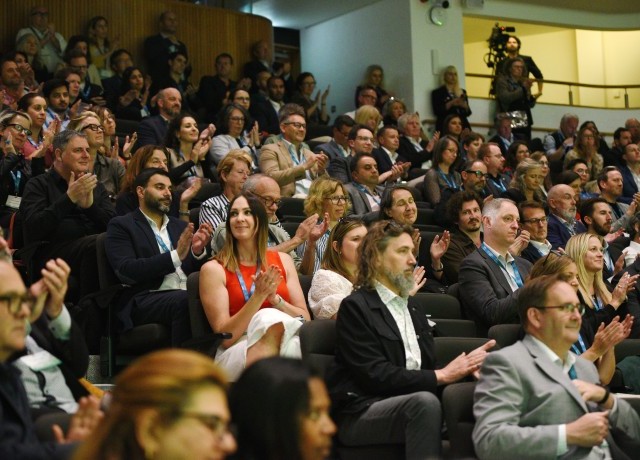
Knowledge + Innovation Theatre
The Knowledge + Innovation Theatre in the Exhibition and Poster Gallery at the Congress offers a dynamic programme of high-impact sessions exploring the intersection of design innovation, social value, and technology in healthcare environments.
Situated at the heart of the Knowledge Zone on the exhibition floor, the theatre provides an accessible platform for knowledge exchange between designers, clinicians, researchers, industry innovators, and health system leaders. Through a series of presentations, case studies, and interactive discussions, speakers will share practical insights into how thoughtful design and emerging technologies can improve patient experience, staff wellbeing, operational efficiency, and long-term system resilience.
Sessions will showcase real-world projects, technology and social innovations that demonstrate how healthcare environments can be shaped to deliver greater social value – supporting quality improvement in clinical care, and improvements in the patient environment.
These sessions encourage open dialogue and invite audience participation, enabling delegates to engage directly with presenters and explore how ideas can be translated into practice. The Knowledge + Innovation Theatre serves as a vibrant hub for inspiration, collaboration, and discovery throughout the Congress.
The full detailed agenda of talks and panels will be announced shortly.
Monday 15 June

Catherine Zeliotis

Stuart McArthur

Cathy Walker

Angela Jackson-Lee
International insights: Who protects patient value when delivery models change?
Abstract Copy
As demand grows, and ageing infrastructure, rising costs, and political pressure push for faster delivery, new approaches – alliance delivery, target-cost contracts, and standardisation – are reshaping how healthcare projects are delivered. These models can unlock speed and cost discipline but they also raise a critical question: when delivery models change, who safeguards patient value so it isn’t quietly traded away for programme velocity? This provocative, cross-border panel brings together a UK contractor, a UK health system leader, and two Canadian clinical leaders to examine how governance, incentives, and requirements either protect – or erode – whole-life outcomes. Drawing on real-world examples, the panel will explore where value engineering tends to “bite first,” how decisions are made under pressure, and what is gained – or lost – along the way.
Evan Rutherford
Key insights from transition planning across 600+ healthcare facilities
Abstract Copy
Transition planning for a new healthcare facility is a complex, multi-faceted endeavour that requires significant time, co-ordination and resources to ensure a seamless shift from construction to day one of clinical operations. This complexity drives the need for integrated planning across operational readiness, facility activation, physical relocation, and patient transfer efforts. By aligning these efforts in a phased approach, it can ensure the building, staff, and systems are fully prepared to deliver safe, efficient patient care from day one.Health Care Relocations (HCR) has provided transition planning and relocation services for more than 600 facilities worldwide. In this presentation, we aim to share some of our expertise on the key timelines and priorities needed to ensure an efficient, safe and seamless transition from the existing facility to the new one. Through the construction, facility activation, and relocation phases, HCR highlights the key requirements at each stage and places emphasis on the key milestones leadership and staff need to achieve to ensure they are well prepared for a smooth and successful transition.
With more than 30 years of industry experience, HCR has developed a highly efficient approach to managing complex projects of large scale. This expertise has been shaped by decades of continuous improvement and valuable lessons learned along the way. This experience has enabled HCR to continually refine its approach with each completed transition project, reflecting its methodology in real-world application where efficiency, patient safety, and operational continuity remain the highest priorities.
Planning and relocating any healthcare facility can feel overwhelming owing to its scale and complexity. By stripping the process back to clear, agreed-upon principles, organisations can bring structure and clarity to what might otherwise seem conceptual. HCR’s guiding principles help streamline decision-making and prevent efforts from getting lost in unnecessary detail. We will explore key insights from those experiences to clearly outline the validated process of successfully relocating a healthcare facility.
Session overview
Abstract Copy
This session explores how healthcare design can respond to wider social challenges and support more inclusive, community-focused models of care. Drawing on UK and international examples, the session examines how healthcare systems can extend beyond traditional hospital boundaries to address social determinants of health, particularly for vulnerable and marginalised populations. It highlights approaches that integrate healthcare with housing, community services, and supportive environments, while also emphasising the importance of co-design and lived experience in shaping more welcoming, dignified spaces.
Tara McGinty

Aileen Igoe

Emma Geoghegan
Included by design: Learning from lived experience to shape inclusive healthcare spaces and services
Abstract Copy
The Inclusion Health team at the Mater Hospital, working in partnership with the Mater Transformation team, has been developing responsive, integrated models of care for people experiencing homelessness, a population with disproportionately high morbidity, accelerated ageing, and markedly reduced life expectancy. Evidence consistently highlights extremely high rates of preventable mortality, with many deaths arising from conditions treatable within mainstream healthcare. Yet access to care is frequently undermined by stigma, trauma, mistrust, and the complexity of navigating fragmented health and social systems. Consequently, many individuals struggle to sustain engagement and rely heavily on emergency services, with some presenting to hospital more than 20 times each year.In response, the team has developed innovative service models, pioneering in the Irish context, which integrate community-based supports directly into acute hospital care. These approaches aim to sustain engagement, improve continuity, and address overlapping clinical and social needs that frequently fall between traditional service boundaries. However, their effectiveness depends not only on how care is organised but also on where it is delivered. Conventional hospital environments, often highly clinical and institutional, can unintentionally reinforce stigma or re-traumatise people who have experienced long-term exclusion from healthcare. This has prompted growing recognition of the need for therapeutic, dignified, and inclusive environments that support relationship-centred, trauma-informed care.
To explore how the built environment might enable such care, the Inclusion Health team collaborated with fifth-year architecture students from the School of Architecture and Built Environment at Technological University Dublin. Students were tasked with reimagining an existing community-based building, scheduled for redevelopment, as a specialist healthcare hub for people experiencing homelessness. Central to this work was a co-design process involving people with lived experience of homelessness, addiction, and repeated engagement with acute hospital services. Through workshops, structured dialogue, and site visits, lived-experience contributors shared insights into what promotes, or undermines, feelings of welcome, trust and safety within healthcare settings.
These contributions directly shaped the students’ design proposals, challenging assumptions and deepening understanding of how inclusive, trauma-informed environments can be realised in practice. The resulting co-designed concepts, reflecting the voices and priorities of those most affected, will be presented. The presentation reflects on key insights from the collaboration, highlighting design principles grounded in lived experience that can inform future models of care for highly marginalised populations. It argues that thoughtfully designed environments are central to improving outcomes, reducing repeat hospital presentations, and enabling people to access and complete care successfully overall.
Learning Objectives
- Understand health inequities and systems of care Examine how this affects people experiencing homelessness, including trauma, stigma, fragmented systems, and built environment, and recognise how integrated inclusion-health models improve access and care
- Apply trauma-informed and inclusive design principles Identify how healthcare environments shape care and patient experience, and define trauma-informed, inclusive, and dignified design principles informed by lived experience and co-design.
- Understand collaborative and co-design approaches in inclusive healthcare: Recognise the value of co-design with people with lived experience, healthcare professionals, designers, architects and students in creating inclusive and sustainable care models

Kerri Culver

Andrew Boozary MD
Social Medicine Housing Initiative (Dunn House)
Abstract Copy
Homelessness is a profound public health crisis associated with reduced life expectancy, accelerated ageing, high rates of co-morbidity, and disproportionate use of emergency and inpatient care. At the University Health Network (UHN) in Toronto, the top 100 patients without fixed addresses accounted for more than 4309 emergency department visits in a single year, highlighting the limits of hospital-based care alone and housing as a core determinant of health. In response, UHN developed the Social Medicine Housing Initiative at 90 Dunn Avenue (Dunn House), Canada’s first hospital-led permanent supportive housing model with on-site health and social services to improve health outcomes and quality of life for chronically unhoused, medically and socially complex patients.The initiative is a partnership between UHN’s Gattuso Centre for Social Medicine, the City of Toronto, United Way Greater Toronto, and Fred Victor. Opening in late 2024, Dunn House prioritises unhoused UHN patients who are among the highest users of emergency and inpatient services. Tenants are cross-referenced with the City’s homelessness registry and selected based on medical complexity, social vulnerability, and homelessness duration, with particular attention to women, Indigenous peoples, and people with disabilities.
The four-storey building contains 51 studio apartments, each 275 square feet with a kitchenette and private bathroom; 15 units are fully barrier-free. Fred Victor operates the building and provides wraparound supports, including case management; housing stabilisation; daily meals; mental health; harm reduction services; personal support worker assistance; justice and system navigation; and community integration programming. Residents also benefit from shared communal spaces, a community garden and on-site commercial kitchen supported by United Way Greater Toronto.
Dunn House demonstrates that stable housing is critical to patient recovery and health equity. By integrating permanent housing with healthcare and community-based supports, the initiative establishes a scalable model for addressing homelessness among vulnerable populations and alleviating strain on acute-care systems.
Constructed using modular building techniques, it minimised construction waste, noise, and emissions while accelerating delivery on constrained urban land. It incorporates sustainable features such as a green roof for insulation and rainwater filtration, energy-efficient systems, and the Bonnie Storr Garden – an outdoor space designed to foster biodiversity and resident wellbeing. The layout prioritises accessibility, community-engagement, and person-centred care, blending healthcare delivery with housing stability.
Externally, it aligns with contemporary residential design strategies, which emphasise open, connected spaces and adaptive reuse of historic elements – a philosophy mirrored in Dunn House’s modular adaptability and community-centric planning.
Learning Objectives
- Access to Housing significantly reduces ER visits and improve outcomes.
- Prefab can increase the availability of rapid housing initiatives and still foster community.
- Designing for Patient centered outcomes.
Tuesday 16 June
Session overview
Abstract Copy
This session explores how healthcare environments can better support people of all ages, abilities, and cognitive needs through thoughtful architectural design. Presentations will demonstrate how inclusive design strategies can enhance orientation, independence, and patient experience
Pascal van Dort
Designing for silence, signal and speech: The three acoustic priorities in healthcare
Abstract Copy
Sound is a critical yet often overlooked dimension of healthcare design, directly shaping patient outcomes, staff performance, and overall wellbeing. This paper explores three interdependent pillars of healthcare acoustics – silence, signal, and speech – as a framework for improving clinical environments.First, silence is essential for rest, recovery, and cognitive function. Excessive and unpredictable noise in hospitals has been linked to sleep disruption, elevated stress, and delayed healing. Design strategies that reduce unwanted noise – through materials, spatial planning, and operational practices – can significantly enhance patient experience and staff resilience.
Second, signal focuses on the clarity and effectiveness of alarms, alerts, and wayfinding systems. In high-stakes environments, poorly designed auditory signals contribute to alarm fatigue, missed cues, and safety risks. Optimising soundscapes to ensure critical signals are distinguishable, timely, and actionable is vital for both patient safety and workflow efficiency.
Third, speech addresses the balance between intelligibility and privacy. Healthcare settings demand clear communication under pressure, yet also require confidentiality for sensitive information. Acoustic design must support accurate verbal exchange among staff while safeguarding patient dignity and trust.
By integrating these three dimensions, healthcare design can move beyond noise reduction towards intentional sound environments that support healing, safety and performance. This paper highlights practical design approaches and emerging insights to guide architects, clinicians and policymakers in creating acoustically intelligent healthcare spaces.

Arif Yildirim
Resilient hospital logistics by design
Abstract Copy
Hospitals today face increasing operational pressure from rising patient demand, workforce shortages, and sustainability targets – all while many facilities continue to operate in buildings designed decades ago. Whether planning a new hospital or upgrading an existing one, the way materials, medications, linen, meals, waste and temperature-sensitive pharmaceuticals move through the building is central to clinical efficiency, patient safety, and regulatory compliance, yet it is often constrained by legacy infrastructure and late-stage technical decisions.In this showcase, Swisslog Healthcare explores how automation and architectural planning, across both new construction and retrofit projects, can work together to create resilient, efficient and future-ready hospitals. Drawing on international experience across Europe, the Middle East, North America and Asia Pacific, the session demonstrates how automated intralogistics solutions, such as pneumatic tube systems, pharmacy automation, autonomous mobile robots (AMRs), automated guided vehicles (AGVs), and integrated cold chain logistics can be successfully implemented in both existing hospitals and new builds.
The presentation highlights practical strategies for retrofitting automation into operational facilities with minimal disruption, including phased implementation, use of existing shafts and corridors, and modular system design. It also shows how early alignment between planners, architects, engineers, pharmacists, and automation specialists – whether at concept stage or during refurbishment – can unlock measurable benefits: reduced staff walking distances; improved medication safety; enhanced infection control; optimised space utilisation; assured cold chain compliance; and lower lifecycle costs.
Attendees will gain insights into:
• key design and infrastructure considerations for automation and logistics in projects;
• how existing hospitals can enhance resilience, safety, and adaptability; and
• why automation-ready design supports long-term flexibility and “agile not fragile” healthcare environments.
This showcase is aimed at leaders and designers seeking to modernise hospital logistics intelligently – whether building new or transforming what already exists.

Robin Snell

Gloria Kain

Per Hellevik Carlsson
Putting the mega hospital on pause: Rethinking capital delivery including community‑based, distributed healthcare infrastructure
Abstract Copy
Across Canada, the United Kingdom, and much of Europe, health systems are confronting a new reality: escalating capital costs, chronic labour shortages, supply‑chain instability, and global economic volatility are fundamentally reshaping how healthcare infrastructure can be planned and delivered. At the same time, successive generations of clinical, technical, and risk‑management standards – often introduced with the best of intentions – have steadily expanded scope, complexity and gross floor area, contributing to longer delivery timelines and rising financial exposure.The traditional mega hospital, characterised by extended planning horizons, concentrated capital risk, and highly customised, “gold‑plated” solutions, is becoming increasingly difficult to deliver and sustain. This raises a critical question for owners, designers and builders alike: have we drifted too far from what is essential towards what is merely desirable? In response, many jurisdictions are re‑examining capital delivery models, exploring distributed, phased, and community‑based investments that emphasise standardisation, adaptability, affordability, and speed to market. This panel brings together international perspectives to examine how rethinking standards, scope control, and delivery strategies can reduce risk, improve value and better align healthcare infrastructure with evolving models of care – supporting a shift from singular, centralised assets to more resilient, system‑wide networks.

Kris Mackay

Rob Trimble
Intentionally radical: What should neighbourhood health become?
Abstract Copy
As neighbourhood health becomes central to the NHS Ten-Year Plan, there is growing recognition that improving population health requires more than co-located services or new healthcare buildings. It requires a fundamentally different relationship between health systems, communities, place and power.Drawing on neighbourhood health, regeneration and system partnership work across multiple UK locations, the session explores how healthier communities are created through connected local ecosystems that bring together health, housing, enterprise, culture and community infrastructure. It examines the role of place-based collaboration in creating long-term social, economic and health impact.
The discussion will reflect on neighbourhood health models that have evolved from grassroots social innovation into nationally recognised systems serving large and diverse populations. It will consider how community capability, participation and local ownership can become foundational to the future of health and care, rather than remaining secondary to clinical integration and estate planning.
At a time when new neighbourhood health policies and delivery models are emerging across the NHS, the session will question whether current approaches risk creating efficient multidisciplinary clinical hubs without fundamentally changing how communities shape and experience health systems. It will explore what it means to be intentionally radical in neighbourhood health: creating places people belong to, not simply buildings they attend.
The session will challenge delegates to think beyond estates, infrastructure and organisational integration, and ask a deeper question: what kind of neighbourhood health future are we actually building?
Rob Trimble, former chief executive of the internationally recognised Bromley by Bow Centre and one of the UK’s leading voices on community-led health and social innovation, joins this session exploring the future of neighbourhood health at a critical moment for NHS reform.